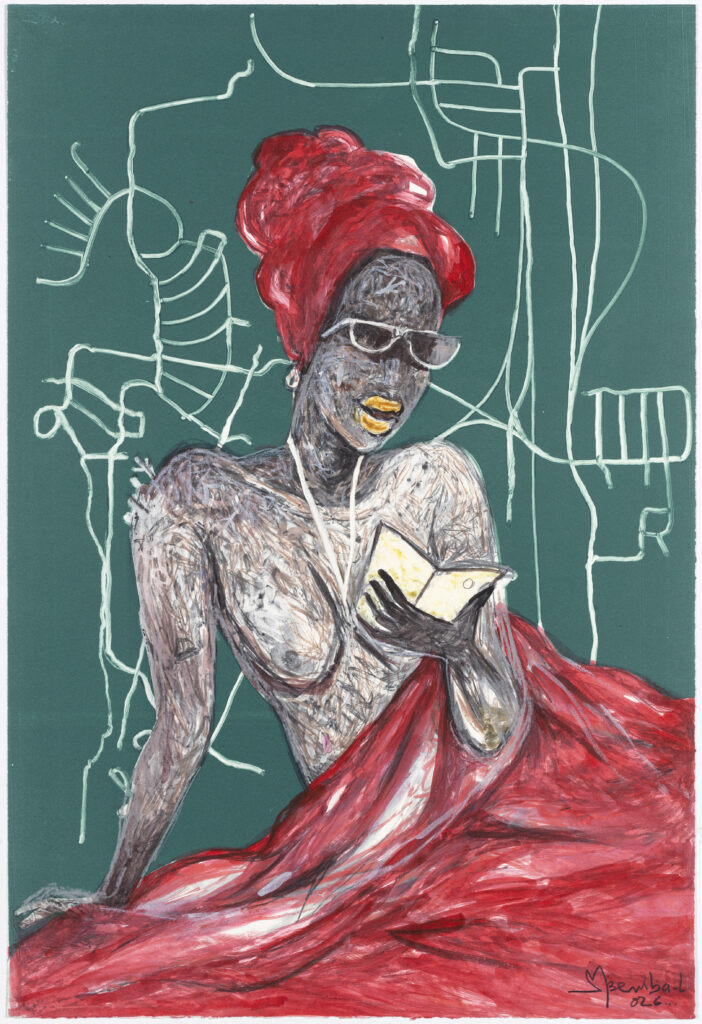
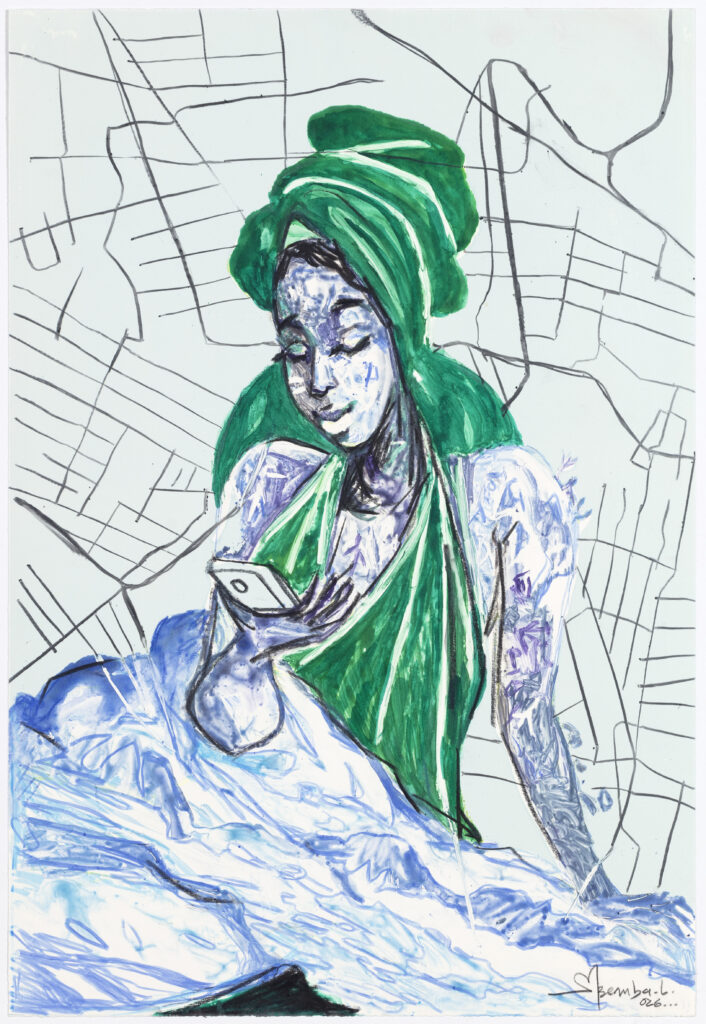
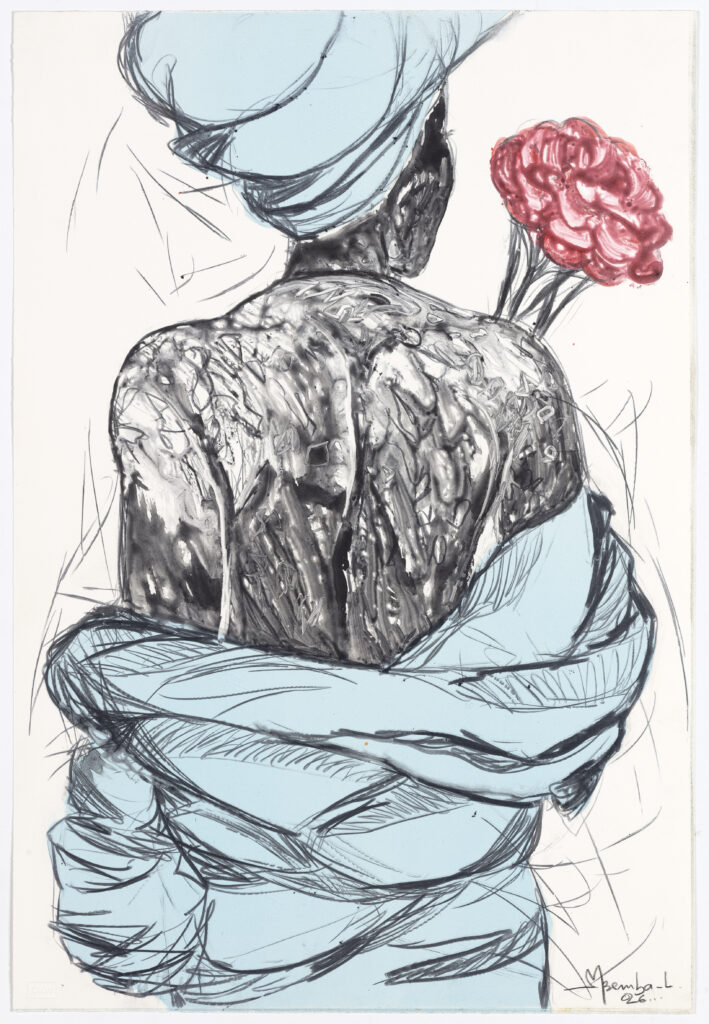
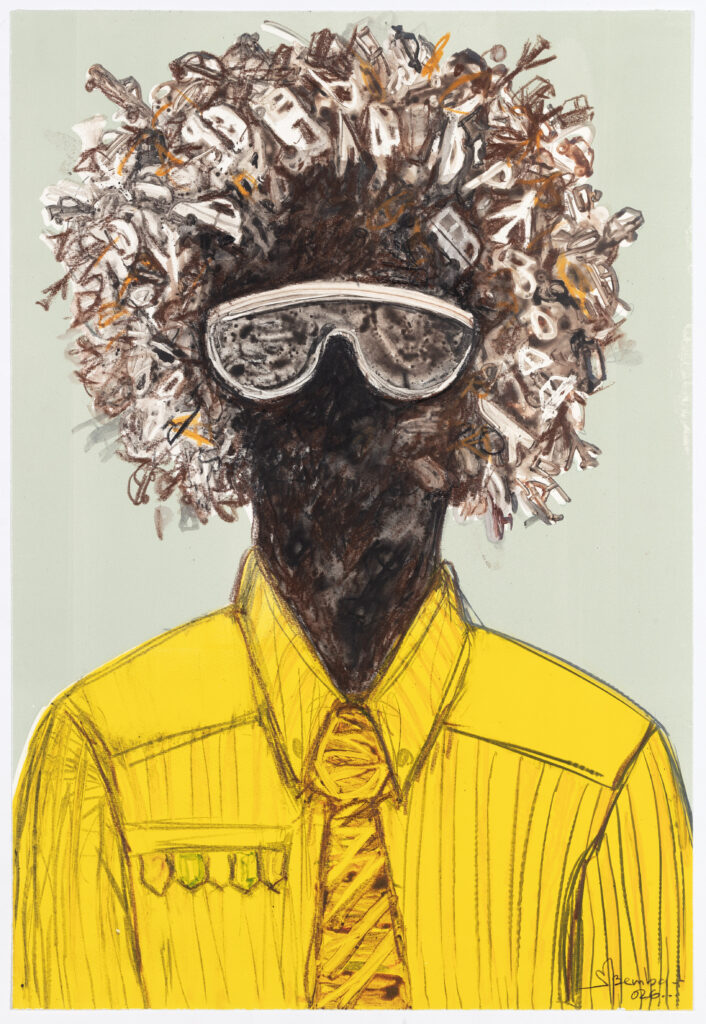
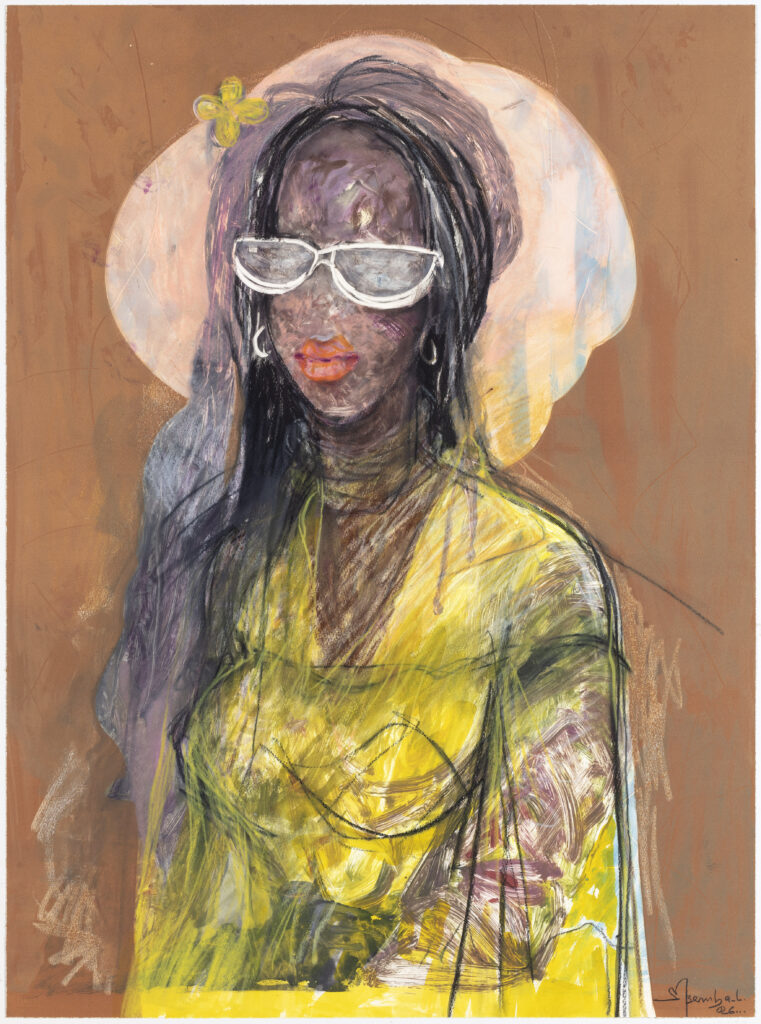
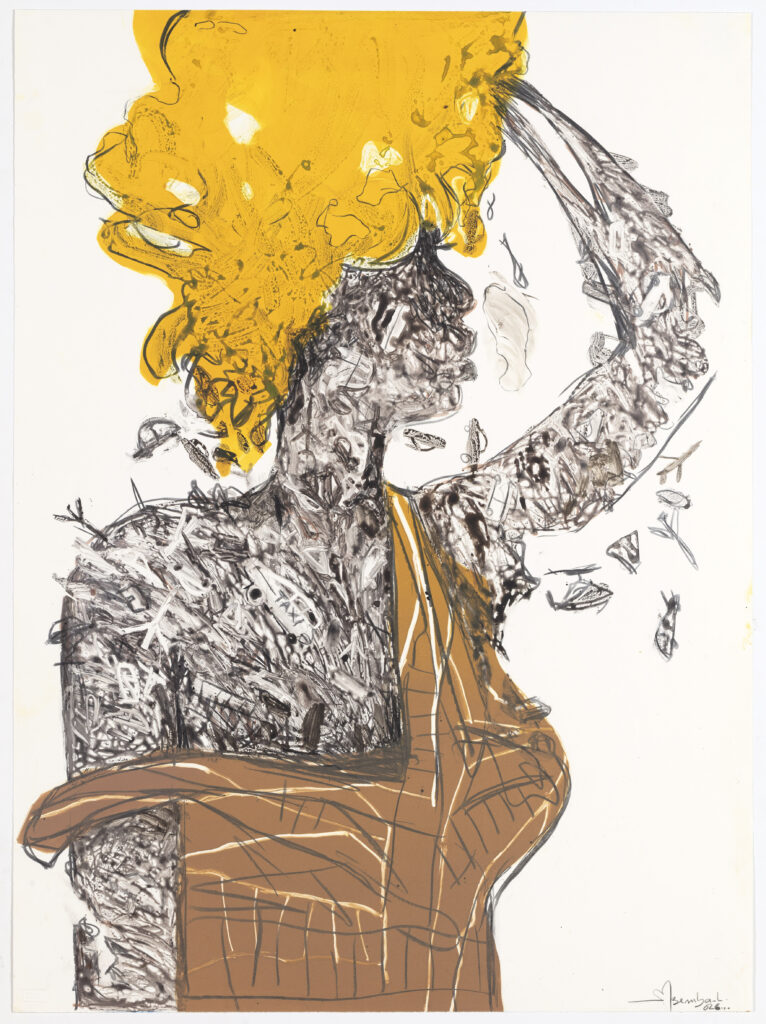
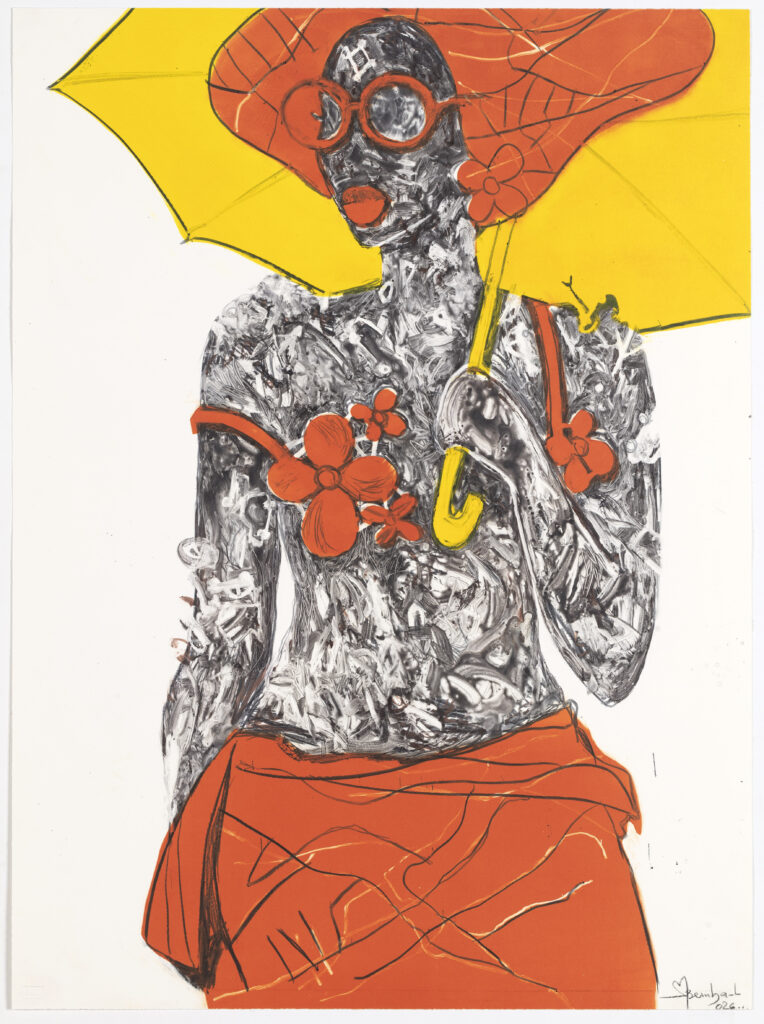
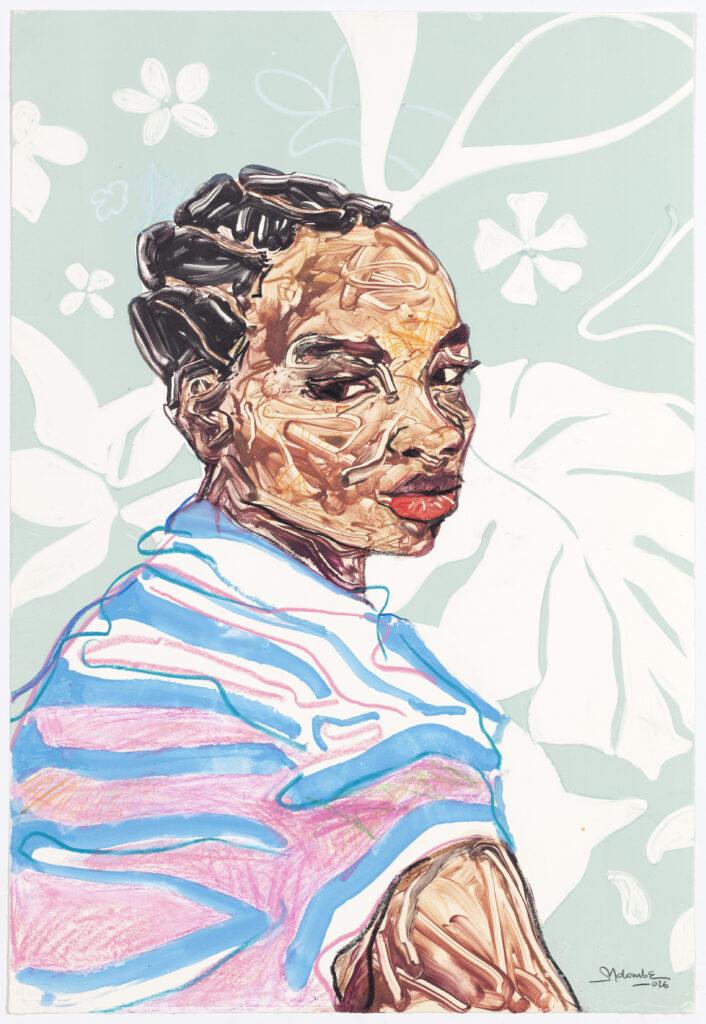
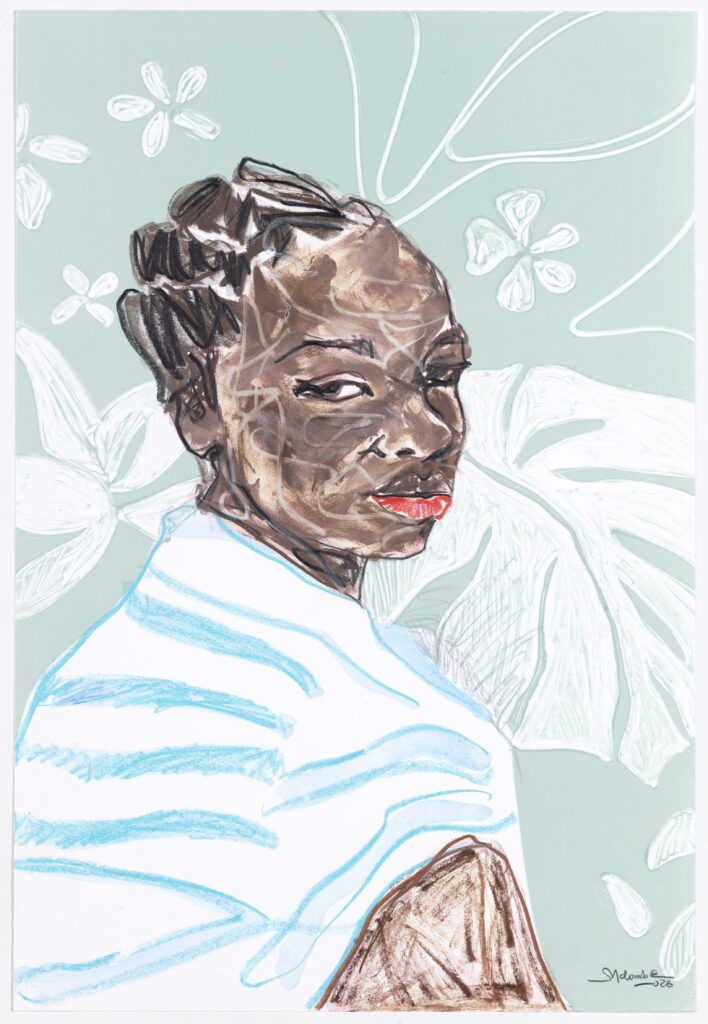
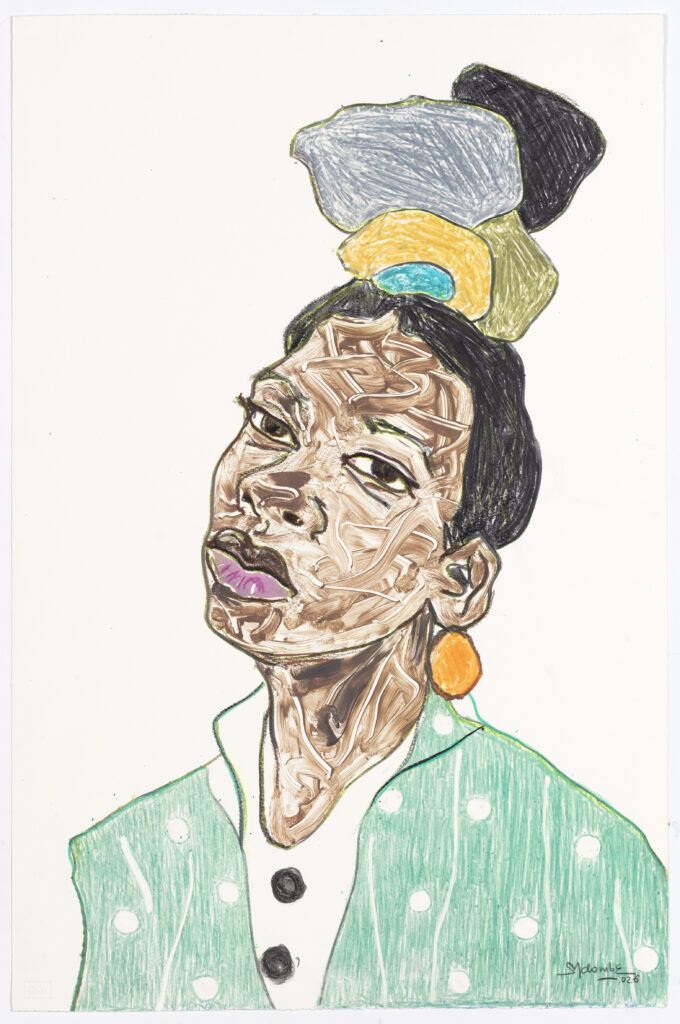
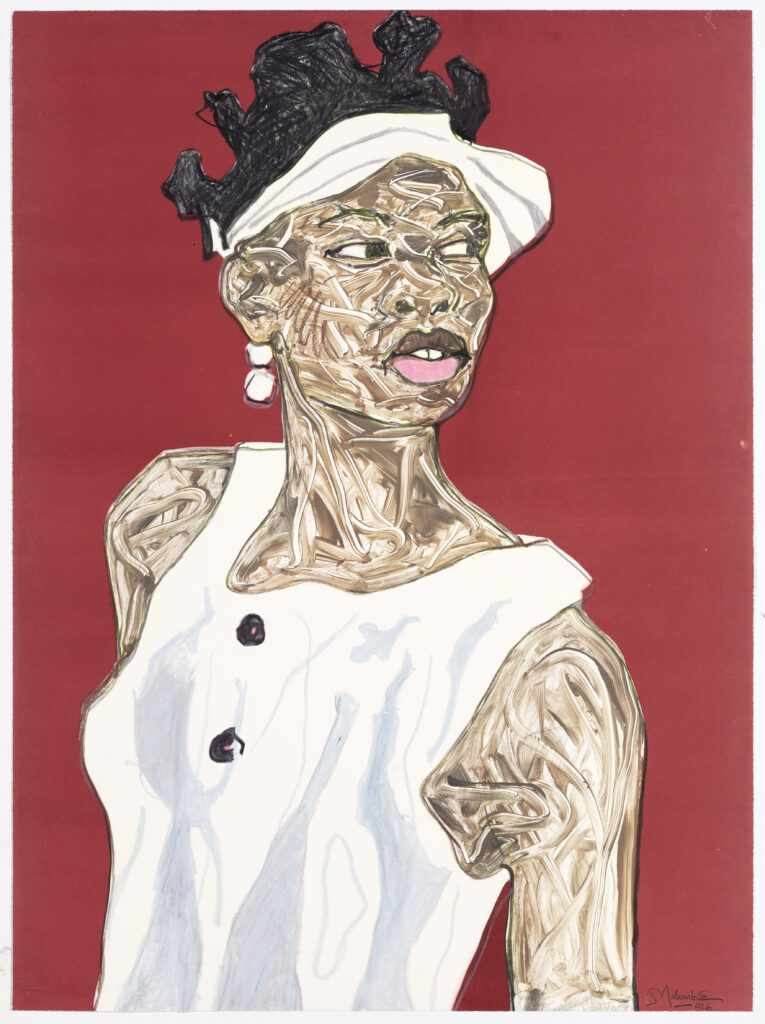
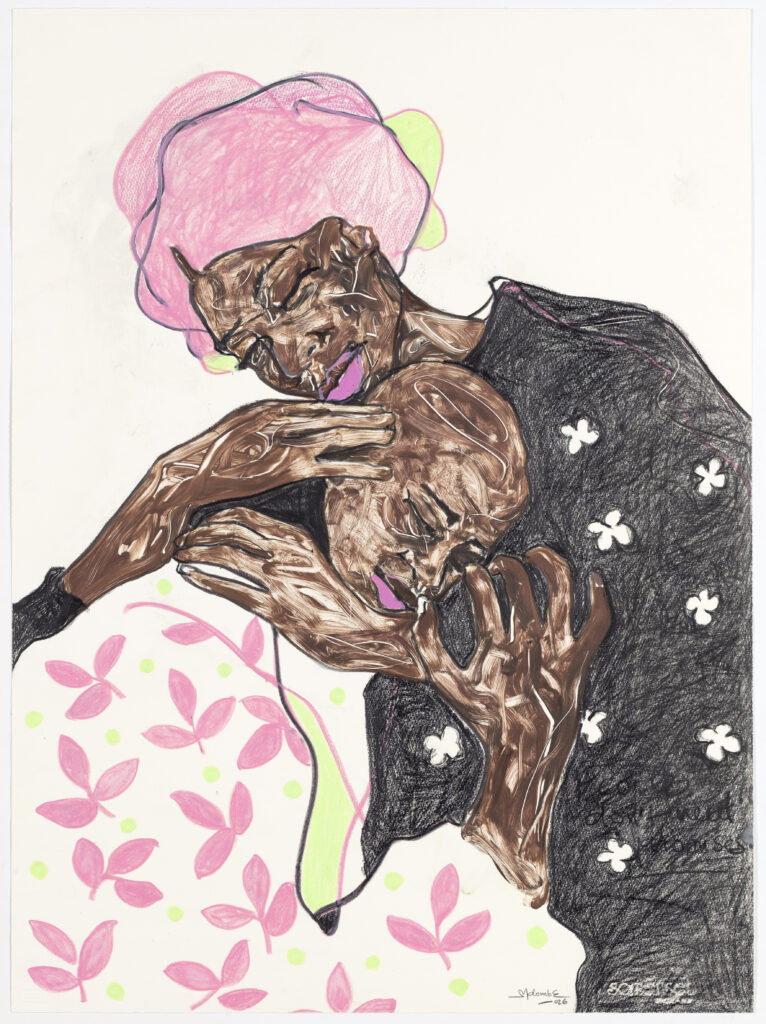
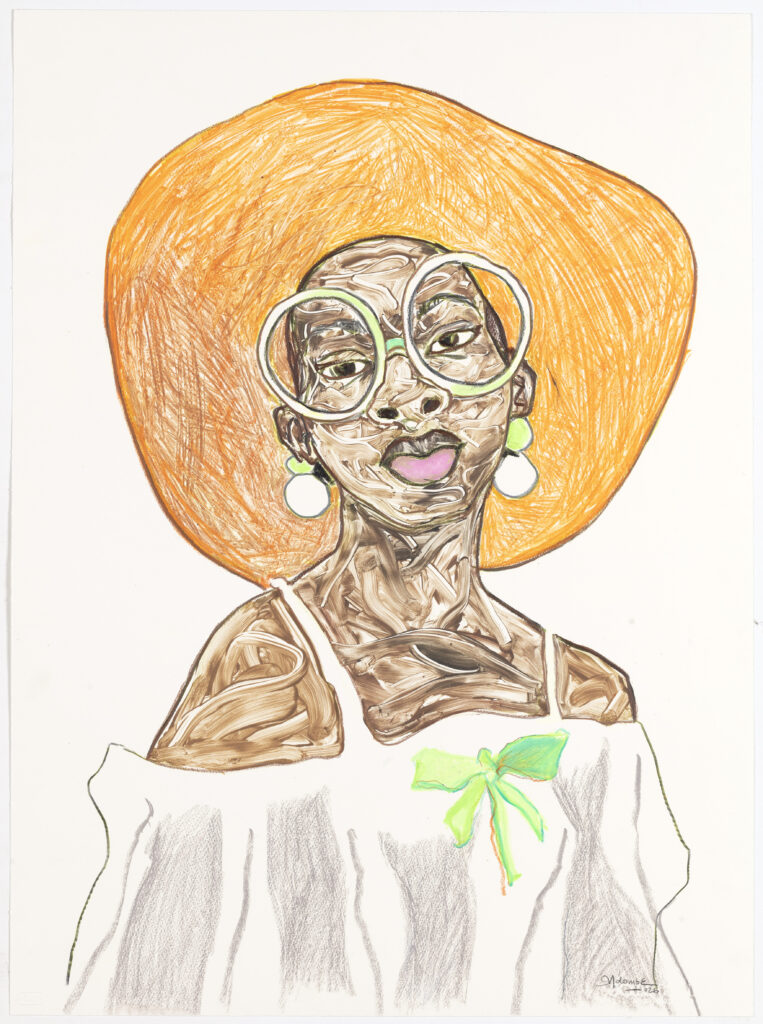
At the 19th edition of the FNB Art Joburg fair in 2026, David had a chance to reconnect with Yvon Edoumou of Gallery Malabo in Kinshasha, whom he had met a year prior. From this discussion arose an opportunity for two artist that they, Gallery Malabo, that is, currently represent to come into the workshop and explore printmaking. On Monday the 7th of September 2026, Sisqo Ndombe and Doudou Mbemba came in to collaborate with DKW’s Sbongiseni Khulu, working with the monotype printing process, a painterly process that sees the artist creating the image on a flat surface, often perspex, and then passing the plate through the printing press, which transfers the image in reverse onto archival paper.
An unusual aspect of this collaboration, however, was the fact that neither artist spoke English, while Khulu does not speak French. This meant that the collaboration saw the trio communicating through gestures, observation and direct physicality. The resulting prints are thus a testimony to the universality art as a visual language that transcends typical, verbal understanding.
MABONENG NEWS, 2026
Mixed media monotype (oil-based and watercolor monotype with woodie handwork)
55.6 x 38 cm
LA DETENTE, 2026
Mixed media monotype (oil-based and watercolor monotype with woodie handwork)
55.6 x 38 cm
OU ES TU?,2026
Mixed media monotype (oil-based and watercolor monotype)
55.6 x 38 cm
MR KIVU, 2026
Mixed media monotype (oil-based and watercolor monotype with woodie handwork)
55.6 x 38 cm
PREMIER JOUR,2026
Mixed media monotype (oil-based and watercolor monotype with woodie handwork)
74.5 x 55 cm
FOULART JAUNE, 2026
Mixed media monotype (oil-based and watercolor monotype with woodie handwork)
74.5 x 55 cm
JOLIE JAUNE, 2026
Mixed media monotype (oil-based and watercolor monotype)
74.5 x 55 cm
The second-born of thirteen children, Doudou Mbemba (b. 1978) was born on the tenth day of November in Boma, in the Kongo Central province. His immense innate talent for drawing led him to the Institute des Beaux-Arts in Kinshasa, where he studied in the Painting Department and obtained his state diploma. The doors of the prestigious Académie des Beaux-Arts de Kinshasa subsequently opened to him, where he continued his studies and graduated with a bachelor’s degree in visual arts, specialising once again in painting.
During his academic journey, his exceptional virtuosity attracted the attention of the renowned artist Roger Botembe, who took him under his wing at the Botembe Studios. There, he worked alongside other leading figures of contemporary Congolese painting. This marked the beginning of a career enriched by numerous collaborations, group and solo exhibitions, both in the Democratic Republic of the Congo and abroad, as well as various awards and honorary distinctions.
Mbemba’s work can be understood as an allegory of a life shaped by struggles and conflicts; a denunciation of a society consumed by egocentrism; and a reflection of a world in which the exception has become the rule, where individualism takes precedence over collective interests. Through a vibrant and striking palette, he critiques social disorder and the inversion of values through his recurring theme of traffic jams. As an engaged artist and passionate advocate of meritocracy, he positions himself as a proponent of an artistic philosophy centred on the need to build a world that promotes everyone’s participation in collective happiness: a coordinated and ordered universe founded on a new paradigm of coexistence, alternation, and shared success.
SPEECHLESS, 2026
Mixed media monotype (oil-based and watercolor monotype with woodie handwork)
55.6 x 38 cm
SPEECHLESS 2, 2026
Mixed media monotype (oil-based and watercolor monotype with woodie handwork)
55.6 x 38 cm
OBSERVER, 2026
Mixed media monotype (oil-based and watercolor monotype with woodie handwork)
55.6 x 38 cm
UNSEEN SCARS, 2026
Mixed media monotype (oil-based and watercolor monotype with woodie handwork)
74.5 x 55 cm
CRACKED PEOPLE, 2026
Mixed media monotype (oil-based and watercolor monotype with woodie handwork)
74.5 x 55 cm
BEYOND THE GAZE, 2026
Mixed media monotype (oil-based and watercolor monotype with woodie handwork)
74.5 x 55 cm
Sisqo Ndombe Akisieful (b. 1985), also known as Lenoir, is a Congolese painter born in Kikwut in the Democratic Republic of the Congo, though he now lives and works in Kinshasha. A graduate of the Academy of Fine Arts in Kinshasa in 2008, he has since devoted his practice to portrait painting. His highly expressive approach is distinguished by the intensity of his subjects’ gazes and by a unique technique: he paints directly with his fingers, creating networks of cracks across the surfaces of faces. These fissures embody inner tensions while also echoing broader contemporary African social realities. His works engage viewers directly, prompting reflection on human, social, and political conditions. Balancing fragility and strength, his figures carry narratives of resistance in which wounds are transformed into spaces of projection, memory, and hope.
His work has been exhibited internationally in numerous galleries as well as in prestigious institutions, including the African American Museum in Philadelphia (USA), the Teloglion Foundation of Arts in Thessaloniki (Greece), and the Constitution Hill Museum in Johannesburg (South Africa). His artworks are now part of several private collections around the world. Recipient of the Orange Social Entrepreneurship Award for Africa and the Middle East in 2021, he continues to develop an artistic practice that explores the connections between memory, resilience, and transformation.
His artistic practice is centered on portraiture as a space for memory, emotion, and social reflection. Through his work, he explores human experiences, contemporary African realities, and the mechanisms of resilience that enable individuals to rebuild themselves in the face of adversity. His painting is distinguished by a distinctive finger-painting technique through which he creates cracks across the surface of his subjects’ faces. These fissures, which have become a signature element of his practice, echo inner tensions and lived memories. They symbolize both visible and invisible wounds, while also celebrating our capacity to reinvent ourselves and transform adversity. The gaze occupies a central place in his compositions. It establishes a direct dialogue with the viewer, inviting a silent encounter with the other. Through this confrontation, Sisqo seeks to reveal the dignity, vulnerability, and strength that coexist within every individual. His work ultimately o”ers a reflection on identity, memory, resilience, and hope, transforming human fragility into spaces of reconstruction, renewal, and new possibilities.